


The increasing ubiquity of computers and related devices (e.g., sensors) and their diffusion into our environment requires a rethinking of the complex interplay between technology and humans. The often quoted observation by Mark Weiser, “The most profound technologies are those that disappear. They weave themselves into the fabric of everyday life until they are indistinguishable from it,” [9] set the stage for the vision of an unobtrusive, calm technology. Since then, the effort to make technologies disappear into the background has been an ongoing endeavour involving a series of international initiatives and innovative program. One prominent example is the proactive initiative “The Disappearing Computer” (DC) launched and funded by the “Future and Emerging Technologies” strand of the IST programme of the European Commission www.disapppearing-computer.net.
As computers disappear from the scene, become invisible, and disappear from the perception of the users [5], a new set of issues is created concerning the interaction with computers embedded in everyday objects resulting in smart artefacts: How can people interact with invisible devices? How can we design implicit interaction for sensor-based interfaces? How can we design for transparency and coherent experiences? One way of tackling these problems is described in the following examples. It is characterized by returning to the real world as the starting point for design and trying to exploit the affordances that real-world objects provide.
Thanks to Mike Yue for the link :)
Saturday, February 11, 2006


PDP2005

PDP2005 is largely over now given that it was essentially a 2005 project, however the evidence stands that blogs can form a vital aspect of pedagogical practice.
I argue that this medium is clearly able to be employed by teachers and students to their achive their respective learning goals.
Simply put the project was blog based from inception and evolved into a simple exercise in research at certifiate level [tertiary].
The project attracted the interest of young Shanghainese designer Mike Yue and he contributed an intriguing brief for the students to contemplate...you can find it on the bottom of the November archive...sorry no permalink :(
Emotion conscious chair design above by Twahn McMahon
Monday, February 06, 2006
Connected | Qualia 06 Exhibition 20/1/06 - 19/2/06
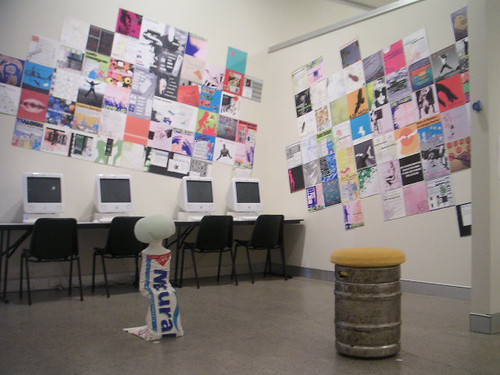
Despite the irony of me feeling rather "disconnected" about what was achieved with this exhibition - overall it looks good...the design exhibition is brash and colourful and a big improvement on last year's show. And that's an achievement I think :-)
On the move
Mobility, nomadic lifestyles, business travel, perpetually linked, email addiction, 21 C viruses that cannot be treated...these are topics I have been pondering of late...additionally the issue/topic of the "digital divide" is something I am curious about...
Seriously interesting posts by Alexandra Deschamps-Sonsino make for interesting reading at present.
I particularly liked the one featuring the quote from Jean-Luc Raymond above...
More info about Jean-Luc can be found on the LIFT06 site.
Less than 20% the world has a connection, Africa represents less than 1% of connected people which will be decreased. The question of access is a problem,
Different age, sex, language, work, skills, etc are much more of a problem than whether they have a computer or not.
Seriously interesting posts by Alexandra Deschamps-Sonsino make for interesting reading at present.
I particularly liked the one featuring the quote from Jean-Luc Raymond above...
More info about Jean-Luc can be found on the LIFT06 site.
Sunday, January 29, 2006
More "C"
Curious about that last statement, I tried the search "Generation C + China"...lead me to this page at World Editor's Forum.
Can anyone be a journalist now?
Can anyone be a journalist now?
Generation C
Well, although I have not been actively posting to CPH127 at this point I have been regularly checking things out. I find "relocation headspace" for the present at least is not compatible with "content creation headspace".
However this morning a post about co-creation by the prolific Hans Henrik H. Heming caught my eye and lead me to discover this. Although I have not pursued any heavy duty "trend watching" for some time as a designer it is clearly something that I have taken a lot of notice of over the years.
So Generation C - what's it about?
Interesting huh? Read on...
I keep thinking about what happens when billions of Chinese kids really start creating their own content...that will be different!
However this morning a post about co-creation by the prolific Hans Henrik H. Heming caught my eye and lead me to discover this. Although I have not pursued any heavy duty "trend watching" for some time as a designer it is clearly something that I have taken a lot of notice of over the years.
So Generation C - what's it about?
No, this is not about a new niche generation of youngsters born between March 12, 1988 and April 24, 1993; the C stands for CONTENT, and anyone with even a tiny amount of creative talent can (and probably will) be part of this not-so-exclusive trend.
So what is it all about? The GENERATION C phenomenon captures the an avalanche of consumer generated 'content' that is building on the Web, adding tera-peta bytes of new text, images, audio and video on an ongoing basis.
The two main drivers fuelling this trend? (1) The creative urges each consumer undeniably possesses. We're all artists, but until now we neither had the guts nor the means to go all out. (2) The manufacturers of content-creating tools, who relentlessly push us to unleash that creativity, using -- of course -- their ever cheaper, ever more powerful gadgets and gizmos. Instead of asking consumers to watch, to listen, to play, to passively consume, the race is on to get them to create, to produce, and to participate.
Interesting huh? Read on...
I keep thinking about what happens when billions of Chinese kids really start creating their own content...that will be different!
Thursday, January 26, 2006

Monday, January 09, 2006
New year | New challenges
The past month or so since my last post has been a period of much required recuperation from the past year. Not only this, it has signalled a need for change in my professional and personal life. Fortunately, in that timely manner that the universe often displays, new opportunities have presented themselves.
So, for me 2006 means a new location, new job and a new and role that from all appearances shows a lot of promise for the future. I'm confident that this represents a reconnection with creativity and practice - something that I have, despite my apparent prolific activity, felt was slipping to the background subsumed by relentless and ineffective administrative bureacracy.
I will elaborate on the details of all this a little further on - the real reason for this post is to get in the swing of it again. I always find that a holiday takes one to a place where it is difficult to get started again.
Here's to 2006 - I hope it is a good one for everyone...
Monday, December 05, 2005
On being radical
Wow!!! What a full on month it has been...no time for much posting - although truthfully it has been on my mind a lot...in amongst all the other more stressful stuff going on.
This link to the work and ideas of Stephen Downes harks back to work I was doing about a year ago working with other teachers to foster awareness and skill development in the area of online delivery.
There is a lot to sift through here. Downes is seen as a key theorist in the area where learning and ICT merge. At present the topic on learning ecosystems seems particularly pertinent and I suggest that those interested in this check out Stephen's site and his ideas on the topic.
Tuesday, November 01, 2005
Culture in Education?
Uppermost in my mind this week are questions of culture in art and design education. Having had conversations with faculty from both the design and the visual arts departments I manage there seems to be almost a complete consensus that this is lacking in contemporary arts education. It is a similar proposition when researching what other academics are saying on this topic...
Sure, we teach history and contextual subjects in design and cultural productions in the visual arts programs but this does tend to be specific and less broad than it might be if one was intending to foster the "curiosity" and excitment about IDEAS that I think most lecturers would like.
It seems that there is a growing lack in this area. But how to stem this if budgets are cut and the overall climate is not conducive to this type of content in curriculum?
Saturday, October 29, 2005
A new forum for discussion about Global Design Education
This week a new innovation occurred in a somewhat spontenious and rapid manner over at CPH127 the excellent weblog about design and innovation.
Essentially the new "runway" [love that airport metaphor :-)] was created in response to a conversation that developed after Niti Bahn posted about Design Education and Culture.
I am hoping that the new blog will evolve into a nice discussion/forum for educators in the field worldwide.
Essentially the new "runway" [love that airport metaphor :-)] was created in response to a conversation that developed after Niti Bahn posted about Design Education and Culture.
I am hoping that the new blog will evolve into a nice discussion/forum for educators in the field worldwide.
Saturday, October 15, 2005
East | West behavioural and thinking dichotomies
The Shanghai Swiss Chamber of Commerce swisscham.org recently commissioned Birds & Fish Communications to work on the development of a quarterly magazine appropriately titled “The Bridge”. Designed to foster more awareness of Swiss Chinese business relations in Shanghai and China generally the publication’s March 2005 issue featured a wonderful article “10 differences between Western and Eastern Behaviour and Thinking” by Hans J.Roth, Consul General of Switzerland in Shanghai. The article describes the most significant differences between European and Chinese cultural environments. Although quite broad brushstrokes the observations can be considered a solid general guideline. I thought it would be positive to share the main points of difference highlighted in the article.
Behaviour Patterns
1.China is a collective society. This means that ‘in-group ’ and ‘out-group ’ differentiation is much more marked than in the West. ‘In-group ’ behaviours are marked by strong consensus patterns. ‘Out-group ’ relations rely on pure Darwinist survival and appear very cold or even brutal to Western eyes. A foreigner is never regarded as belonging to the group, which partly explains the difficult working environment for foreigners in China.
2.Personal relationships play a key role in any collective society. There is no abstract ethical system like in Europe. Morality is linked to the quality of the relationship. If this quality is bad, cheating will be normal. If it is good, it is more reliable than a relationship in the West. So even among criminals there might be a strong solidarity -or none at all.
3.Competitive behaviour is very common in this kind of system, even within the group. But an ‘in-group ’ competition can switch immediately to a neat and closed co-operation if the group is attacked from outside. Competitive behaviour and closed ranks strongly mark Chinese behaviour patterns. Such competition takes place on individual as well as on group levels. The highest level of solidarity is that of the Chinese as an ethnic group.
International solidarity is therefore even more difficult to be achieved than in a Western environment.
4.China is a collective mass society. Thus privacy is very strongly reduced. Everybody knows everything about everybody else. This makes life for foreigners, used to less limited individual space and privacy, not always easy.
5.Chinese usually act in accordance with the group.Self- responsibility is therefore rarely taken. Responsibility lies with the whole group.
Thinking Patterns
6.Chinese thinking envisions reality as a constant flow, whereas Western thinking understands reality as a sequence of static moments. The Chinese see reality as a film, a Westerner as a sequence of photographs.
7.Chinese consider reality in a synthetic way. The dialectic process of analysis (thesis, anti-thesis, and synthesis)has never been made. Chinese reality is thus not analysed. It is grasped in an intuitive way. It remains, therefore, quite undifferentiated, but paradoxically enough, much more precise at the same time. The assessment of reality by all the senses leads to a much deeper understanding of the actual moment.
8.Chinese thinking is thus concrete and pragmatic, it does not
analyse reality. Given the short spatial and temporal horizons, Chinese thinking is concentrated on the actual moment in the actual situation. This kind of thinking conflicts with a Wetern-style rational planning process. It has, however, the big advantage of a complete feeling of reality at a particular place and time. Furthermore, the future is seen in a visionary way, with full confidence that the development of time will actually show the ways to realise these visions.
9.Being synthetic, Chinese thinking has no problems in integrating contradictions in the understanding of reality. Western thought has considerable problems with this. In fact,from the point of view of the Western mind, the Chinese way does not seem to be logical and rational. For a Westerner, it is hard to understand something as positive and negative at the same time. For the Chinese, however,the presence of yin and yang at every moment has a long philosophical tradition. There is no concept of an either/or. The two, rather, always go together and characterize reality by their contradictions.
10.Chinese thinking does not accept absolute and eternal truths. Whether something is still true tomorrow, the reality of tomorrow will show.
The Bridge, Shanghai, March 2005 Text: Hans J.Roth, 2004
Why share this knowledge? I would maintain that by developing a more subtle appreciation of the difference culture can make on thinking and behaviours in business contexts we can make better use of the creative innovation process as it increasingly intersects across a global/glocal business environment.
Has anyone else had experience of this kind of divergence in cross-cultural communications as they relate to design and product / service development?
Friday, October 07, 2005
Home for the Byron office of Birds & Fish Communications - Day 4

Home for the Byron office of Birds & Fish Communications - Day 4, originally uploaded by Ian McArthur.
The contrast could not be greater. This bay with Suffolk Park in the middle distance is the Australian home for the Birds & Fish Communications team. "Vivid" is the word the Shanghai design team used to describe the place. Guess they are right. It is very interesting seeing this place through their eyes...
Monday, September 19, 2005
Off Nanjing Lu downtown

Like I was saying, I think people who have never been to China, or more precisely who have never lived there do not understand how amazing, disorientating, frustrating, expensive, deceptive or how beautiful it is...
Start Small - Dream Big
In 5 days I will be visited by a small group of three very important young people. They are important because for a number of years we have collaborated on a design project to build a brand offering design services from China to the world. We have had some success. the group has grown from a collaboration of two struggling to envisage our small dream to a slightly bigger group that has for the most part become a self sustaining entity.
The group has reached a stage where potential and actual clients approach us from all corners of the planet curious about the work we do. Equally so we field enquiries from students from Europe and America and other places asking for internship opportunities in order to gain insight into the Chinese culture and we assume a towe in the door of the rapidly expanding opportunity there.
Yet we are really just a small group of friends who have an idea. One of us summed it up well in our last newsletter - "Start Small - Dream Big"...
Whereas once what has been achieved would have been a thing simply not to be contemplated. A 'foreigner" working collaboratively with Chinese designers - now it seems to be a matter on a lot of people's minds. It is well documented. The most recent issue of IDN magazine. featured a not so tongue in cheek article pointing out that everyone "wants to be Chinese"...
So my friends, one of which has never left China previously are making their way to Australia to visit, gain insights into what they see as "a wonderful place". What strikes me as I ponder this is the differences in perception. As one who has lived in China and Australia and has seen both sides of the story unfolding, I am curious about the paradox of East West relationships in business, politics and at more personal levels and experiences. I for example would relocate back to Shanghai without much hesitation should the opportunity arise
I look at the way westerners see China as some kind of "goldrush" to be exploited. I smile a little as the lambs head for the slaughter fascinated by what will consume and perhaps destroy them. This evening while buying petrol [that most precious of commodities] I was confronted by a woman openely ridiculing a man of Asian appearance.
I am looking forward to seeing my friends very much.
Saturday, September 17, 2005
Getting into Flickr
Following the lead of several on CPH127 I've been looking at how I can use FlicKr...Feel free to have a browse through the three sets I've created so far - including one set of images from trhis past week of meetings and promotional activities. Our facilities in Arts & Media NCI are fabulous as I think the images show.
I've also added this morning a lot of images of Bangkok. As we are currently looking forward to the possibility of relocating to this amazing city I wanted to refresh my memories of the place and share the richness of the imagery there...Design seems to be a natural part of the Thai way of life. As a culture [somewhat like Indonesia] creativity, improvisation [innovation] is a natural thing for people to do.
I've also added this morning a lot of images of Bangkok. As we are currently looking forward to the possibility of relocating to this amazing city I wanted to refresh my memories of the place and share the richness of the imagery there...Design seems to be a natural part of the Thai way of life. As a culture [somewhat like Indonesia] creativity, improvisation [innovation] is a natural thing for people to do.
Spotted
I thought the Displaced Designer project was an interesting one as well as an example of innovation bourne of neccessity.Social Design Notes also caught my attention the other day...John Thakera's Blog Doors of Perception is always of interest as well...
Monday, September 05, 2005
Open Production and the three Chinas...
Thanks to Hans Herick over at CPH127 for the post on John Hagel's work on Edge Perspectives. It led me to his interesting essay about developments in the emergent India and China markets.
Of particular interest to me was this extract:
As a stakeholder in a small but rapidly blossoming "privately-held company [sic] emerging on the edge of the Chinese economy", I can attest to the accuracy of these claims. Certainly we are not yet getting the attention we might because the focus is still on the major western companies that are jostling to get into the market though truthfully still struggling to understand it.
For all the talk about China - few westerners outside those who venture there to live understand the culture - and even then they remain outsiders. That is the mystery of China. That is the fascination.
Of particular interest to me was this extract:
Open production - the third pattern of innovation
Now, what about China? This is where the Business Week coverage is most disappointing. In fact, one of the articles makes the observation that “China is surprisingly weak in innovation.” I beg to differ. In fact, I would argue that China, along with India, is rapidly becoming the global center of management innovation.
What explains this divergence of views? First, at least in its coverage of China, Business Week seems to equate innovation with product innovation, while I give at least as much emphasis to the importance of process innovation. Second, Business Week seems to ignore the fact that there are three Chinas: rural China, the state-owned enterprises (SOEs) and the private, entrepreneurial sector. Much of Business Week’s coverage concentrates on the state-owned enterprises which still account for the bulk of China’s industrial production and are usually the partners that Western companies choose to affiliate with when they enter China. But, the state-owned enterprises, favored with massive subsidies from the government and low-cost loans from the state-owned banking system, have almost no incentive to innovate. In this arena, it is not surprising that Business Week finds little innovation.
The cauldron of management innovation is in the third China – the growing array of privately-held companies emerging on the edge of the Chinese economy. These companies rarely receive much attention from the Western press, in part because they have developed a culture of keeping a low profile. JSB and I have written extensively about the management innovations being pioneered by these companies in The Only Sustainable Edge.
The contrast with the patterns of innovation among Indian companies is intriguing. These entrepreneurial Chinese companies (which also include a number of high tech Chinese companies in Taiwan) are focused primarily on competing in global markets in product categories like electronics hardware, textiles and motorcycles where product lives are compressed and demand is highly uncertain. These companies are pursuing a third pattern of business innovation focused on re-conceiving the economics of production in order to more effectively mobilize distributed expertise for both product development and manufacturing – let’s call this the “open production” pattern of innovation. The process innovations in this case include:
* modular design of products and processes
* management techniques to flexibly configure highly customized business processes encompassing hundreds, if not thousands, of specialized business partners
* management techniques to encourage business partners to work together in ways that enable them to get better faster than they could on their own.
These are innovations in their own right, but their real power comes from the fact that these management techniques establish the conditions for even more rapid incremental innovation in products and processes. Think of it as meta-innovation - management innovations that spawn a continuing series of innovations.
As a stakeholder in a small but rapidly blossoming "privately-held company [sic] emerging on the edge of the Chinese economy", I can attest to the accuracy of these claims. Certainly we are not yet getting the attention we might because the focus is still on the major western companies that are jostling to get into the market though truthfully still struggling to understand it.
For all the talk about China - few westerners outside those who venture there to live understand the culture - and even then they remain outsiders. That is the mystery of China. That is the fascination.
Sunday, September 04, 2005
There is no need for a "culture of fear"
I felt this report on the paralysis brought on by fear - that feeling of helplessness we experience in the face of overwhelming disaster as heartening. I found it on the website of The Guardian newspaper from London. read the article here.
We need to remind ourselves that communities often possess remarkable capacities to rebuild their lives. The experience of history indicates that humanity can survive disasters. The good news is that life goes on.
After 9/11, New Yorkers showed tremendous resilience and community spirit. That much of this positive legacy was frittered away by short-sighted policies does not detract from the inspiring way in which New Yorkers succeeded in getting on with life. In Asia, after the tsunami, we saw many examples of communities overcoming and recovering from the devastation they had suffered.
The meaning that we derive from last week's disaster need not be that it justifies a culture of fear. Instead, this tragedy can stimulate us to clarify who we are and what we believe is the purpose of life. The absence of consensus on the meaning of a disaster represents an opportunity for a debate about the kind of society we want to build. The way to minimise the influence of the fear merchants is to focus on working out a shared way of interpreting future misfortunes.
· Frank Furedi is professor of sociology at the University of Kent. His Politics of Fear: Beyond Left and Right is published by Continuum Press this month
Saturday, September 03, 2005
A time for reflection
Jessica Helfand writes eloquently at Design Observer on the "Black Tsunami"...
To write about design in the wake of such tragedy seems to trivialize it — and yet, it is precisely in the acknowledgment of design that some kind of reality is once again established. There will be, no doubt, issues raised by this hurricane and its questionable aftermath — issues relating to disaster relief and even municipal reconstruction — that require a kind of vital, critical and engaged visual dialogue. But for now, we wait. We read. We empathize, extend ourselves, reach out in other ways. And we reflect, in these last, fragile days of summer, on the painful irony of a world in which the material evidence of our man-made environment can be pulled from under us in an instant, by a cascading torrent of wind and rain. Design is, can be, should be about so much more than making things that can vanish in a storm.
To write about design in the wake of such tragedy seems to trivialize it — and yet, it is precisely in the acknowledgment of design that some kind of reality is once again established. There will be, no doubt, issues raised by this hurricane and its questionable aftermath — issues relating to disaster relief and even municipal reconstruction — that require a kind of vital, critical and engaged visual dialogue. But for now, we wait. We read. We empathize, extend ourselves, reach out in other ways. And we reflect, in these last, fragile days of summer, on the painful irony of a world in which the material evidence of our man-made environment can be pulled from under us in an instant, by a cascading torrent of wind and rain. Design is, can be, should be about so much more than making things that can vanish in a storm.
Subscribe to:
Posts (Atom)